
Laser Source: The heart of a laser welding machine is the laser source, which generates the high-energy laser beam. The most commonly used laser types are solid-state lasers (such as Nd: YAG and fiber lasers) and CO2 lasers. Each type has its own characteristics, including wavelength, power output, and pulse duration, which determine the machine’s performance and suitability for specific applications.
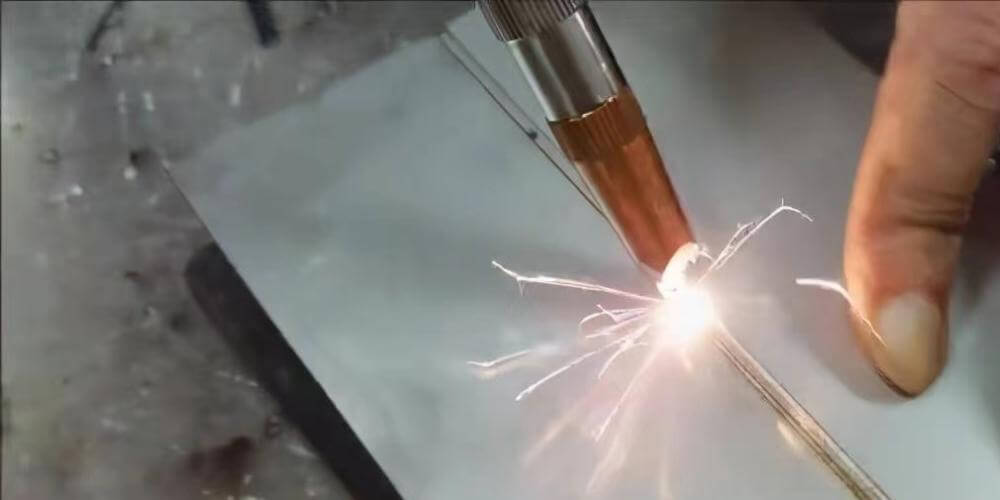
Beam Delivery System: The laser beam is delivered from the laser source to the welding point through a beam delivery system. It typically consists of mirrors, lenses, and fiber optic cables. The system ensures precise focusing and delivery of the laser beam to the desired location.
Welding Head: The welding head holds the focusing optics and controls the position and movement of the laser beam. It provides the necessary stability and flexibility for welding different types of materials and geometries. Some advanced welding heads incorporate automated features like rotation, tilting, and scanning to enable complex welding patterns.
Workpiece Fixturing: To ensure accurate and repeatable welding, the workpiece needs to be securely held in place during the welding process. Various fixturing methods, such as clamps, jigs, or robotic arms, are used depending on the application requirements.
Control System: The control system of a laser welding machine manages the laser source, beam delivery, and other system parameters. It allows operators to set the welding parameters, such as power, pulse duration, and welding speed. Advanced control systems often feature real-time monitoring, data logging, and pre-programmed welding profiles for different materials.
Safety Measures: Laser welding machines employ several safety measures to protect operators and prevent damage to the equipment. These include enclosed work areas with laser-safe barriers, interlocks, and sensors to detect unauthorized access or exposure to the laser beam. Operators are typically required to wear appropriate safety gear, such as laser safety glasses.
Advantages: Laser welding machines offer several advantages over traditional welding methods. They provide precise control over the heat input, resulting in minimal distortion and smaller weld zones. The non-contact nature of laser welding eliminates the need for direct physical contact with the workpiece, reducing the risk of contamination or damage. Laser welding can be performed on a wide range of materials, including metals, plastics, and even dissimilar materials. Additionally, laser welding is faster and more efficient than conventional methods, making it ideal for high-volume production.
Applications of laser welding machines include automotive manufacturing, aerospace, electronics, medical devices, jewelry, and various other industries where precision and efficiency are crucial.