
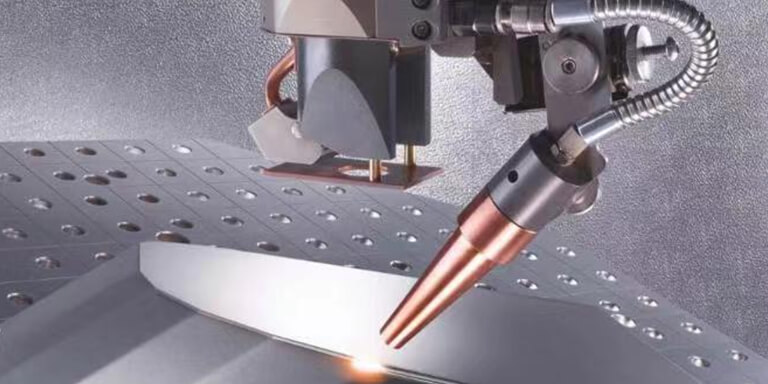
Under most of the application occasions, Inert gases like Helium, Argon and nitrogen are often used during welding process to protect welding pool from getting oxidated. Here we would like to share the information on what the functions of the protective gases are?
Through nozzle exit, protective gas gets to welded part surface at a certain pressure, so the shape of nozzle and diameter of the exit are very important. The nozzle exit should be big enough so the ejected protective gas can cover the welded part surface. However, to effectively protect protection lens and avoid metal vapor or metal splash from damaging protective lens, the diameter of the exit should also be limited. The flow rate of protective gas should also be controlled, otherwise the laminar flow of protective gas becomes floc flow, air will be involved and eventually forms air hole.
1.Helium: Not easily ionized (ionization energy is higher), laser can pass easily. Laser beam can arrive at parts surface without any barrier. Helium is the most effective protective gas, but the price is relatively high.
- Argon: Relatively cheaper, density is bigger, so the protective effect is relative good. But it can get ionized easily by high temperature metal plasma, which results that partial laser will be blocked, reducing the effective laser power and also losing welding speed and fusion depth. The welded part surface with argon is more smoother than that with helium.
3.Nitrogen: the cheapest one, but not applicable for some types of stainless steel, mainly because of metallurgy issues, like absorption, sometimes air holes can be generated at joint area.
The second function of using protective gas is to protect the focusing lens from metal vapor contamination and metal splashing. Especially when high-power laser welding, because the splashing becomes very powerful, it is more necessary to protect the lens under this circumstance.
The third function of the protective gas is that it is very effective in dissipating the plasma shield produced by high-power laser welding. The metal vapor absorbs the laser beam and ionizes into a plasma cloud, and the protective gas around the metal vapor is also ionized due to heat. If too much plasma is present, the laser beam is somewhat consumed by the plasma. Plasma exists on the working surface as a second energy, which makes the penetration shallow and the surface of the weld pool widen. The recombination rate of electrons is increased by increasing the three-body collisions of electrons with ions and neutral atoms, to reduce the electron density in the plasma. The lighter the neutral atoms are, the higher the collision frequency is and the higher the recombination rate is; on the other hand, only the protective gas with high ionization energy will not increase the electron density due to the ionization of the gas itself.
It can be seen from this that the size of the plasma cloud varies as the protective gas changes, the smallest is helium, the second is nitrogen, and the largest is when argon is used. The larger the plasma size, the shallower the penetration. The reason for this difference is firstly due to the different degree of ionization of gas molecules, and also due to the difference in the diffusion of metal vapor caused by the different densities of the protective gas.
Helium is the least ionized and least dense gas, and it quickly drives off rising metal vapors generated from the molten metal bath. Therefore, using helium as a shielding gas can suppress the plasma to the greatest extent, thereby increasing the penetration depth and increasing the welding speed; due to its light weight, it can escape and is not easy to cause air holes. Of course, from our actual welding effect, the effect of argon protection is also not bad.